
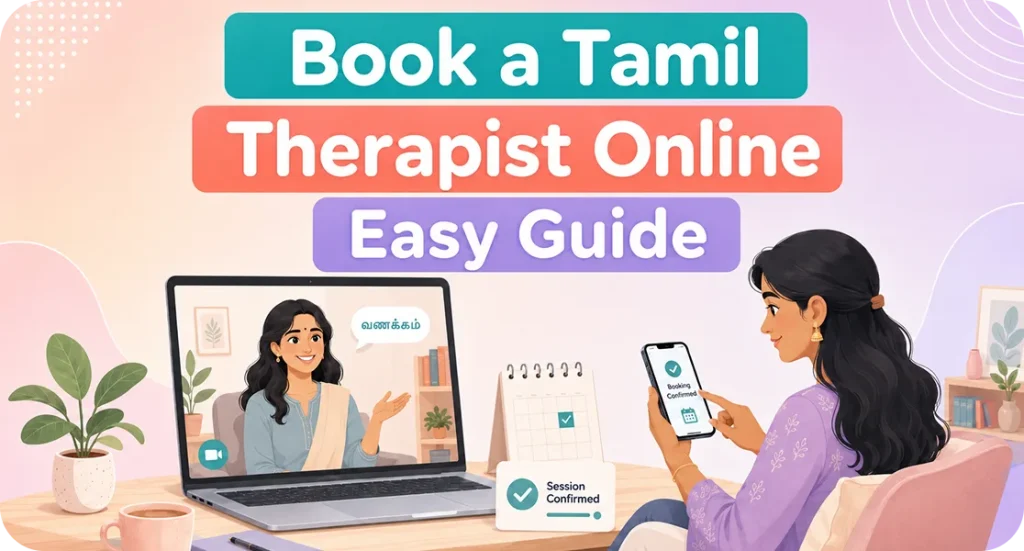
How to book Tamil speaking therapist online?You are searching for a tamil therapist?. You open Google and the list appears, names, credentials, platforms, prices. Everything looks professional. But there is one question sitting at the back of your mind that you cannot quite bring yourself to type directly into the search bar:
Will they actually speak Tamil? Will they understand my concern? Will they understand my family situation without me having to explain it from scratch? Will the context just make sense to them, without me spending half the session becoming their introduction to South Indian family culture?
Need to Talk to Someone?
Book a private online session with a licensed therapist
This matters more than most people realise. Online Therapy works through language, not just the words, but the emotional weight behind them. When you describe your mother’s expectations, your marriage pressure, your career anxiety, or your loneliness in a second language, something gets lost. The precision. The feeling. The exact texture of what you are trying to say.
Finding a Tamil-speaking therapist online is not just a language preference. It is a clinical decision that affects the quality and depth of your therapy.
But here is the problem: not every platform that lists “Tamil-speaking doctors” is giving you what you think you are getting. Some platforms list therapists who speak Tamil but have no training in Tamil cultural contexts. Some list doctors — psychiatrists — when what you need is a psychologist. Some have long waiting times, opaque credentials, or no real quality filter beyond self-reported language ability.
This article tells you exactly what to look for How to book Tamil-speaking therapist online, the questions to ask before booking, why cultural competence goes beyond language, and how Oppam’s Tamil counselling is built specifically for this gap.
Why Language in Therapy Is a Clinical Issue — Not a Preference
Let us settle this first, because it changes everything about how you approach the search.
Research published in Psychotherapy Research by Aragno and Schlachet confirmed that patients working in their first language produce significantly richer, more emotionally connected therapeutic material than those working in a second language — even when bilingual and fluent in both. The emotional memory, the earliest relational experiences, the felt sense of family dynamics and self-worth: these are encoded in the language in which they were first experienced.
When a Tamil person in Chennai describes “அம்மா என்னோட decisions-ஐ always question பண்றாங்க” in English as “my mother questions my decisions” — the clinical content is there but the emotional weight is not. The therapist hears the information but not the texture. Therapy becomes less precise, less effective, and more effortful for the patient.
This is not theoretical. It is the reason that culturally competent, language-matched therapy consistently produces better outcomes for South Asian patients than generic English-language therapy — documented across multiple studies in International Journal of Social Psychiatry examining mental health service outcomes in South Asian diaspora populations.
A Tamil-speaking therapist is not a luxury. It is the clinically appropriate choice.
What "Tamil-Speaking Therapist" Actually Means — and What to Watch For
Not all Tamil-speaking therapists are the same, and the difference matters.
Language Ability vs Cultural Competence
A therapist can speak Tamil fluently and still have limited understanding of the specific psychological pressures of Tamil family life — the weight of academic achievement expectations, the arranged marriage timeline pressure, the caste dynamics that surface in relationship conflicts, the particular guilt of a Tamil NRI who has “made it” but feels empty inside.
Cultural competence means the therapist understands these contexts without requiring you to explain them. It means they do not pathologise normal Tamil family dynamics while also recognising when those dynamics are causing genuine harm. It means they can work within the cultural framework rather than applying a generic Western psychological template that does not fit.
When evaluating a Tamil-speaking therapist, ask: have you worked with Tamil patients specifically? Do you understand the specific pressures of Tamil Nadu academic and career culture? Are you familiar with the Gulf Tamil diaspora experience?
Doctor vs Therapist: The Critical Distinction
Many platforms listing “Tamil-speaking doctors” are listing psychiatrists — medical doctors who can prescribe medication and manage severe mental health conditions. This is not what most people searching for a Tamil therapist online need.
For the majority of presentations — anxiety, depression, relationship difficulties, work stress, family conflict, low self-esteem, grief — a psychologist or counselling psychologist is the appropriate professional. They provide structured psychological therapy: CBT, ACT, IPT, relationship counselling. They do not prescribe but can refer to a psychiatrist when medication is also indicated.
Searching for a “Tamil-speaking doctor” and landing on a psychiatrist when you need a psychologist is a category mismatch that can result in medication being offered when what you actually need is therapy. Both have their place — the question is which one fits your specific situation.
Credential Verification
Ask directly: what is your specific qualification? For psychologists in India, the meaningful credentials are M.Phil. in Clinical Psychology from an RCI-accredited institution, M.Sc. in Clinical or Counselling Psychology from a recognised university, or doctoral-level training. RCI (Rehabilitation Council of India) registration is the regulatory standard for clinical psychologists.
A qualified professional will provide this information without hesitation. Vagueness about credentials is a red flag regardless of language ability.
What Makes Oppam's Tamil Counselling Different
Oppam was built specifically for the Malayalam and Tamil-speaking South Asian communities — not as an afterthought, not as a language filter added to a generic platform, but as the foundational design principle.
Therapists Who Understand the Tamil Context
Oppam’s Tamil-language therapists are not simply Tamil speakers who happen to offer therapy. They are clinicians who work specifically with Tamil and South Asian patients, who understand the specific pressures of Tamil Nadu’s high-achievement academic culture, the weight of family expectations in Chennai and Coimbatore households, the particular loneliness of a Tamil professional in the Gulf who cannot tell anyone back home how he really feels, and the complex guilt of second-generation Tamil diaspora in the UK or Canada who do not fit either culture fully.
This is the difference between a therapist who speaks your language and a therapist who understands your world.
Structured, Evidence-Based Therapy
Oppam’s therapists are trained in Cognitive Behavioural Therapy, Acceptance and Commitment Therapy, Interpersonal Therapy, and relationship counselling — evidence-based approaches with strong research support for anxiety, depression, relationship difficulties, and stress. According to a meta-analysis published in Psychological Medicine, CBT produces large effect sizes across all major anxiety and depressive disorder categories, with effects durable at long-term follow-up.
Therapy at Oppam is structured and goal-oriented — not open-ended, indefinite talking. Sessions have a purpose, a direction, and a measurable outcome.
Online Access With Real Privacy
For Tamil patients in Chennai, Coimbatore, Madurai, Trichy, Salem, and across the Tamil diaspora globally, Oppam’s online format removes the most consistent barrier to seeking therapy: the fear of being seen.
In Tamil Nadu’s densely networked social environments — where the same people who know your family also know your colleagues, your neighbours, and your temple community — walking into a mental health clinic is a visible act with social consequences. Online therapy from home, via secure video call, is private by design. No waiting room. No community visibility. No disclosure required to anyone before you are ready.
A systematic review published in World Psychiatry confirmed that online therapy produces outcomes equivalent to in-person delivery across all major mental health conditions. The clinical quality is not compromised. The privacy is.
Five Questions to Ask Before Booking a Tamil-Speaking Therapist
Whether you are considering Oppam or any other platform, these questions will help you evaluate the fit before committing.
The first question is about credentials: what is your specific qualification, and are you RCI-registered? This is the single most important quality filter and a qualified professional will answer it directly.
The second question is about cultural experience: have you worked specifically with Tamil patients? Do you understand the specific pressures of Tamil family dynamics, academic culture, and the Gulf Tamil diaspora experience?
The third question is about therapeutic approach: what specific therapeutic method do you use and why is it appropriate for my presenting concern? A named, evidence-based approach is more reassuring than a vague reference to holistic practice.
The fourth question is about language: will the entire session be conducted in Tamil, or will it switch to English for clinical terminology? For some patients, Tamil throughout is important; others are comfortable with Tanglish. Clarify this before the first session.
The fifth question is about structure: how many sessions do you typically recommend for someone with my presenting concerns, and what will sessions involve? Structured therapy has a direction; indefinite open-ended practice is harder to evaluate.
What Conditions a Tamil-Speaking Therapist Can Help With
Oppam’s Tamil-language therapists work with the full range of common mental health presentations that Tamil patients bring.
Anxiety and stress — generalised anxiety, social anxiety, exam and performance anxiety, panic, and the specific chronic stress of managing Tamil family expectations alongside career and personal ambitions. According to the WHO, anxiety disorders affect approximately 301 million people globally, with Tamil Nadu’s high-pressure academic and professional culture creating specific vulnerability in this population.
Depression — including high-functioning depression that presents beneath maintained performance, low mood that has been present for months without being named, and the specific flatness that comes from living a life built entirely around obligation rather than genuine choice.
Relationship and family difficulties — marital conflict, arranged marriage adjustment, parent-child relationship stress, boundary difficulties with joint family systems, and the communication breakdown that happens when Tamil families do not have a shared language for emotional experience.
Career and academic stress — NEET and entrance exam pressure, workplace anxiety, career direction confusion, burnout in high-performance professional environments in Chennai and other Tamil Nadu cities.
Gulf and diaspora Tamil experience — the specific loneliness of the Tamil NRI who is financially successful and emotionally isolated, the second-generation Tamil diaspora in the UK or Canada navigating two cultures imperfectly, and the re-adjustment stress of returning to Tamil Nadu after years abroad.
When to Seek Professional Help
Seek a Tamil-speaking therapist online if anxiety, low mood, relationship difficulties, or work stress have been present on most days for more than four weeks and are affecting your ability to function — at work, in relationships, or in daily life. If sleep is consistently disrupted. If you are relying on alcohol or other substances to manage the way you feel. If the thought “ennakku enna achu nu theriyala” — “I don’t know what’s wrong with me” — has become a daily companion.
You do not need a dramatic crisis to access therapy. You do not need a diagnosis before your first session. You need only to decide that the current level of suffering is worth addressing properly rather than continuing to manage alone.
Online counselling in Tamil Nadu through Oppam is accessible from anywhere — Chennai, Coimbatore, Madurai, Trichy, Salem, or anywhere in the Tamil diaspora globally. Sessions are in Tamil and English, available via secure video call, with no GP referral required. Book your first session →
Finding a Tamil-speaking therapist online is not just about language — it is about finding someone who understands your world well enough to help you make sense of it. Oppam’s Tamil-language counselling is built specifically for this: therapists who speak Tamil, understand Tamil family dynamics, and are trained in evidence-based approaches that actually work. Online counselling in Tamil Nadu is available from anywhere — no referral, no clinic visit, sessions in Tamil and English. Book your first session →
Frequently Asked Questions
Where can I find a Tamil-speaking therapist online?
Oppam offers Tamil-speaking therapists online for patients across Tamil Nadu and the Tamil diaspora globally. Sessions are conducted in Tamil and English via secure video call, accessible from Chennai, Coimbatore, Madurai, Trichy, Salem, and anywhere with an internet connection. Therapists are trained in evidence-based approaches including CBT and relationship counselling, and understand the specific cultural contexts of Tamil family life, academic pressure, and Gulf diaspora experience. No GP referral is required to book.
Is online therapy in Tamil as effective as in-person therapy?
Yes. A systematic review published in World Psychiatry confirmed that online therapy produces outcomes equivalent to in-person delivery for anxiety, depression, relationship difficulties, and stress. For Tamil patients specifically, online therapy has the additional advantage of privacy — no clinic waiting room, no community visibility, full scheduling flexibility. The therapeutic relationship that drives outcomes transfers fully to the video call format.
What is the difference between a Tamil-speaking doctor and a Tamil-speaking therapist?
A doctor — specifically a psychiatrist — is a medical professional who can diagnose and prescribe medication. A therapist or psychologist provides structured psychological therapy without prescribing. For most presentations of anxiety, depression, relationship difficulties, and stress, a psychologist is the appropriate first choice. If medication is also indicated, a psychologist can refer to a psychiatrist. Many platforms listing “Tamil-speaking doctors” primarily list psychiatrists — check whether you actually need a psychologist before booking.
How do I know if a Tamil therapist online is properly qualified?
Ask for their specific qualification — M.Phil. in Clinical Psychology, M.Sc. in Counselling Psychology, or equivalent — and their RCI (Rehabilitation Council of India) registration number for clinical psychologists. A qualified professional will provide this information without hesitation. Also ask specifically about their experience with Tamil patients and their therapeutic approach. Vagueness about any of these is a reason to look elsewhere.
Can I get online therapy in Tamil for anxiety and depression?
Yes. Oppam offers online therapy Tamil for both anxiety and depression, with therapists trained in CBT and other evidence-based approaches that have strong research support for both conditions. Sessions are in Tamil and English, accessible from anywhere in Tamil Nadu or the Tamil diaspora. According to NICE guidelines, CBT is the first-line psychological treatment for both anxiety disorders and depression.
How much does a Tamil-speaking online therapist cost?
Session fees vary depending on the therapist’s qualifications and experience. Oppam’s sessions are priced accessibly for Tamil Nadu and diaspora patients, with transparent fees visible before booking. No hidden charges, no mandatory packages. For patients in Chennai, Coimbatore, Madurai, and other Tamil Nadu cities, online therapy is typically more affordable than in-person private practice while delivering equivalent clinical outcomes.
Therapist kita Tamil-la pesuvanam — does that actually help more than English therapy?
Yes, and the evidence supports this. Research published in Psychotherapy Research confirmed that patients working in their first language produce richer, more emotionally connected therapeutic material than those working in a second language — even when bilingual. When you describe your family dynamics, your relationships, your fears in Tamil — the precision and emotional authenticity are greater. The therapy goes deeper, faster. Working with a Tamil-speaking therapist who also understands Tamil cultural context is the combination that produces the best outcomes.
External Resources
- Psychotherapy Research (Aragno and Schlachet) — First-language advantage in therapy; richer emotional material and better outcomes when working in native language
- World Psychiatry — Systematic review confirming equivalence of online and in-person therapy outcomes across major mental health conditions
- International Journal of Social Psychiatry — Mental health service outcomes in South Asian diaspora populations; cultural competence and language-matched therapy
- Psychological Medicine — Meta-analysis of CBT efficacy for anxiety and depression; large effect sizes and durable outcomes at follow-up
- NICE (UK) — CBT as first-line psychological treatment for anxiety disorders and depression; evidence-based treatment guidelines
Struggling?
Talk to an Oppam Therapist
Get the Support You Deserve Online & Confidential